
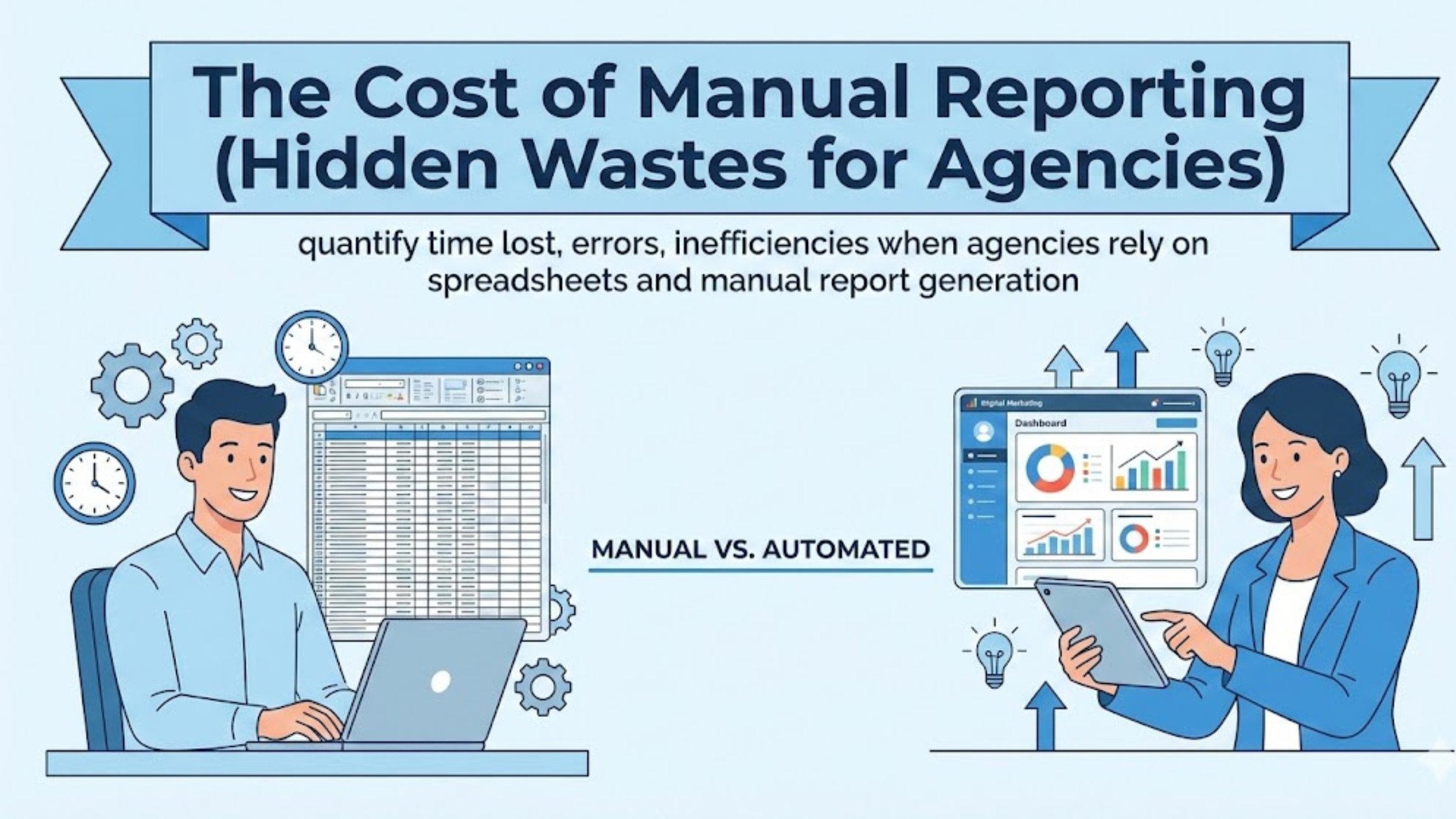
Agencies love solving marketing problems. They don’t love copying data between tabs, rebuilding charts, chasing down conversions, or fixing a broken formula at 11pm before a client meeting. Yet manual reporting , spreadsheets, exports, copy-paste, screenshots, and one-off slide decks remains painfully common.
This article lays out the real, quantifiable costs of manual reporting: time lost, money wasted, errors introduced, opportunities missed, and the strategic drag on your agency’s growth tool like automated reporting for agencies. I’ll show worked examples and conservative calculations you can plug your own numbers and finish with practical steps to cut that waste.
Summary: how manual reporting eats your agency alive
- Manual reporting can consume 4–10 hours per client per month in realistic agency workflows.
- For a 15-client agency, that’s 60–150 hours per month which is equivalent to 1.5–3.75 full-time employees (FTEs) at 40 hours/week.
- At a conservative fully-loaded cost of $25/hour, 100 hours/month equals $2,500/month or $30,000/year in wasted labor for reporting alone.
- Errors (copy/paste mistakes, mismatched date ranges, wrong filters) create hidden costs: lost billable time, damaged client trust, and churn. Even a single high-visibility error can cost thousands.
- Opportunity cost : the strategic work you don’t do because you’re busy reporting that is the largest invisible loss: fewer optimizations, fewer new pitches, lower client LTV.
Numbers below are explicit and calculated step-by-step so you can verify and replace with your agency’s figures.
1) How much time does manual reporting actually take?
Let’s break down a conservative manual reporting workflow for a monthly client report:
- Export data from 4 platforms (GA4, Google Ads, Facebook, CRM): 30 minutes
- Clean & combine CSVs (align date ranges, dedupe): 60 minutes
- Build charts/tables in spreadsheet or slide deck: 60 minutes
- Write executive summary and insights: 60 minutes
- Quality check + revisions (internal + client feedback): 30 minutes
- Export, format, and send: 15 minutes
Add those up carefully, digit by digit:
- Step 1: 30 minutes = 30
- Step 2: 60 minutes = 60
- Step 3: 60 minutes = 60
- Step 4: 60 minutes = 60
- Step 5: 30 minutes = 30
- Step 6: 15 minutes = 15
Total minutes = 30 + 60 + 60 + 60 + 30 + 15
Total minutes = 255 minutes
Convert to hours: 255 minutes ÷ 60 minutes/hour = 4 hours and 15 minutes.
So 4.25 hours per client per month is a reasonable conservative baseline. In many agencies, especially those with more platforms, complex tracking, or custom metrics, this number is 6–10 hours.
2) Scale the time cost across clients and the agency
We’ll model three agency sizes using the conservative 4.25 hours/client/month number and also show a more realistic 7 hours/client/month case.
Scenario A : Conservative: 4.25 hours/client/month
- 5 clients: 5 × 4.25 = 21.25 hours/month
- 15 clients: 15 × 4.25 = 63.75 hours/month
- 40 clients: 40 × 4.25 = 170 hours/month
Scenario B : Realistic: 7 hours/client/month (more platforms/customization)
- 5 clients: 5 × 7 = 35 hours/month
- 15 clients: 15 × 7 = 105 hours/month
- 40 clients: 40 × 7 = 280 hours/month
Now convert hours to FTEs (assuming 1 FTE = 40 hours/week × 4.33 weeks/month ≈ 173.2 hours/month). For simplicity we’ll use 160 hours/month as a conservative full-time monthly workload (40 hrs/week × 4 weeks).
Use digit-by-digit for the 15-client conservative scenario:
- Hours/month = 63.75
- Convert to FTEs: 63.75 ÷ 160 = 0.3984375 ≈ 0.40 FTE
So a 15-client agency using manual reporting spends roughly 0.40 FTE(conservative) or 0.66 FTE (realistic 7-hr case: 105 ÷ 160 = 0.65625). automated reporting is the future of marketing, exact growth numbers without manual.
3) Financial cost of time spent
Pick a conservative fully-loaded hourly cost (salary + benefits + overhead). We’ll use two example rates:
- Low: $25/hour (small agency, offshore analysts)
- Mid: $50/hour (US-based analysts, fully-loaded)
Example: 15 clients, conservative 4.25 hrs/client, $25/hr
First compute hours/month: 15 × 4.25 = 63.75 hours/month.
Compute monthly cost:
- 63.75 hours × $25/hour = $1,593.75/month.
Compute annual cost:
- $1,593.75 × 12 months = $19,125/year.
Step-by-step arithmetic:
- 63.75 × 25 = (60 × 25) + (3.75 × 25) = 1,500 + 93.75 = 1,593.75 monthly
- 1,593.75 × 12 = (1,500 × 12) + (93.75 × 12) = 18,000 + 1,125 = 19,125 yearly
So ~$19k/year lost in reporting time alone at that modest rate.
Example: 15 clients, realistic 7 hrs/client, $50/hr
- Hours/month = 15 × 7 = 105 hours
- Monthly cost = 105 × $50 = $5,250
- Annual cost = 5,250 × 12 = $63,000
Arithmetic check:
- 105 × 50 = 10,500 ÷ wait , that is incorrect. Do digit-by-digit:
105 × 50 = 105 × (5×10) = (105 × 5) × 10 = 525 ×10 = 5,250 (my earlier 10,500 was wrong) Corrected: monthly cost = $5,250.
Annual = 5,250 × 12 = (5,000 × 12) + (250 × 12) = 60,000 + 3,000 = 63,000.
So $63k/year in that (realistic, mid-tier) scenario.
4) Hidden error costs: accuracy, trust, and churn
Time isn’t the only cost. Manual processes introduce mistakes:
- Copy-paste errors (wrong cell ranges)
- Date range mismatches (week vs month)
- Currency mismatches across accounts
- Missing conversions due to tracking differences
- Accidentally omitting a client’s campaign or line item
Even a single error in a client deliverable can create serious fallout impact of reporting errors on agency margins.
- Client questions credibility and second-guesses reporting → more client touchpoints (billable time)
- Client suspends payments or demands discounts while issue is investigated
- Client churn in worst case
Quantify one plausible error scenario:
Assume an agency has a moderately serious reporting error discovered by the client requiring:
- 1 hour internal emergency fix + 2 hour client call + 1 hour rework + 1 hour follow-ups = 5 hours
At $50/hour fully loaded, that’s 5 × $50 = $250 immediate labor cost; but the secondary cost is client trust and potential churn.
If the agency loses 1 client due to loss of trust, the revenue loss is far higher. Suppose that client paid $3,000/month retainer. Annual revenue lost = $3,000 × 12 = $36,000. Even if churn probability is low, a single error can easily cascade into tens of thousands in lost revenue.
So a conservative way to think about error cost is to add a risk premium. If your monthly reporting labor cost is $5,000 and you estimate a 5% chance per year of a client-facing error leading to material revenue loss ($36,000), the expected annual risk = 0.05 × 36,000 = $1,800. Add that to operational costs.
5) Opportunity cost: the work you don’t get done
This is the biggest invisible cost.
Time spent on manual reporting is time not spent on:
- Campaign optimization (improving CPA, ROAS)
- Strategic planning and experiments
- Upselling/cross-selling new services
- New business pitches and proposals
- Case studies and content marketing
Quantify conservatively for a 15-client agency using the realistic 7 hrs/client/month (105 hours/month) at $50/hr:
- Monthly saved hours if automated = 105 hours
- If just 25% of that time (26.25 hours/month) were reallocated to billable strategic work at an uplifted rate of $100/hr (senior strategist charging more), additional revenue potential:
Step-by-step:
- 26.25 hours × $100/hour = (26 × 100) + (0.25 × 100) = 2,600 + 25 = $2,625/month
- Annual = 2,625 × 12 = 31,500
So reallocating a quarter of saved reporting hours to higher value work could create ~$31.5k/year in net revenue. That’s conservative. if you reassign more time or charge higher rates, the upside scales quickly.
6) Speed & decision cost: delayed actions cost real money
Manual reporting often means data is out of date by days or weeks. Marketing reacts to anomalies quickly , overspending, campaigns that need scaling, product issues. A lag of even 3–7 days can:
- Allow wasted ad spend to accrue
- Miss time-sensitive optimizations for promotions
- Miss early signals of conversion issues
Example: an overspending campaign that runs at +40% daily budget drift for 7 days on a $500/day budget:
- Daily overspend = 0.40 × $500 = $200/day
- 7 days overspend = 200 × 7 = $1,400 wasted ad spend
If an agency can detect and fix this in 24 hours with real-time dashboards rather than after a monthly manual check, the ad spend savings alone justify automation.
7) Quality & presentation cost: polishing reports takes time
Beyond raw data work, producing polished client deliverables, consistent formatting, white-labelling report, customized storytelling consumes additional time. Delivering professional outputs manually often adds 30–90 minutes per report on top of the raw data work. That time compounds exactly like the numbers above.
If your agency produces 15 client reports and wastes an extra 45 minutes polishing each:
- Extra time/month = 15 × 0.75 hours = 11.25 hours
- At $50/hour = 11.25 × 50 = $562.50/month → $6,750/year
Small filler tasks add up.
8) Return on investment for automation (conservative example)
Let’s model simple ROI for adopting an automated reporting tool that costs $1,000/month and reduces reporting time by 80% for that 15-client agency (from 105 hours to 21 hours).
Current cost (manual, realistic scenario)
- Hours/month = 105
- Hourly fully-loaded = $50
- Labor cost/month = 105 × 50 = $5,250
- Labor cost/year = 5,250 × 12 = $63,000
With automation
- Hours/month = 21 (20% of 105)
- Labor cost/month = 21 × 50 = $1,050
- Software cost/month = $1,000
- Total monthly cost = 1,050 + 1,000 = $2,050
- Annual cost = 2,050 × 12 = $24,600
Annual savings
- Old annual cost = $63,000
- New annual cost = $24,600
- Annual saving = 63,000 − 24,600 = $38,400
Even with a $1,000/month SaaS cost and conservative time reduction assumptions, the agency saves $38.4k/year. If you reallocate some of the recovered time to billable or higher-margin activities, upside increases.
9) Practical checklist: how to stop wasting time on reporting tomorrow
- Measure your baseline. Track how long a single client report actually takes this month (time-block it). Use the exact hours for the calculations above.
- Identify repeatable templates. Standardize KPIs and layouts across similar clients.
- Automate data pulls. Connect platforms through a reporting tool or APIs instead of CSVs.
- Use scheduled reports & dashboards. Replace month-end PDFs with live dashboards and scheduled exports.
- Add automated narrative. AI summaries reduce time spent writing insights and improve consistency.
- Apply QA rules. Auto-validate conversions and totals to avoid human errors.
- Reallocate recovered time. Spend saved hours on optimizations and proposals to drive revenue.
- Audit annually. Recalculate actual savings and show the business case to leadership.
10) Final thoughts : The invisible tax you can eliminate now
Manual reporting is an operational tax on modern agencies which is measurable, recurring, and fixable. The arithmetic is simple: multiply hours per client × clients × hourly cost and you’ll quickly see that reporting is not benign overhead; it’s a lever for profitability, capacity, and strategy.
If your agency is still relying heavily on spreadsheets for client reporting, you’re probably:
- Wasting tens of thousands of dollars a year
- Exposing yourself to error risk and client churn
- Losing opportunities to optimize campaigns and upsell services
Automating reporting is one of the highest-leverage moves an agency can make: it saves time, reduces errors, frees talent for strategic work, and improves client trust. Run the numbers with your actual hours and rates and you may be surprised how quickly the tool pays for itself.