
In many marketing agencies, reporting conversations tend to follow a familiar pattern. Clients ask whether campaigns are “working,” account managers pull multiple reports, and leadership looks for quick clarity. Yet, confusion often arises not because of missing data, but because the wrong reporting format is being used.
The terms dashboard and scorecard are frequently used interchangeably, even though they serve different purposes. This misunderstanding can lead to overloaded reports, unclear client communication, and unnecessary follow-ups. For agencies managing SEO, paid ads, social media, and analytics at scale, understanding Dashboard vs Scorecard is no longer optional—it is operationally essential.
Dashboard vs Scorecard: Simple Definition
To understand the difference, both concepts should be viewed through an agency lens rather than a technical one.
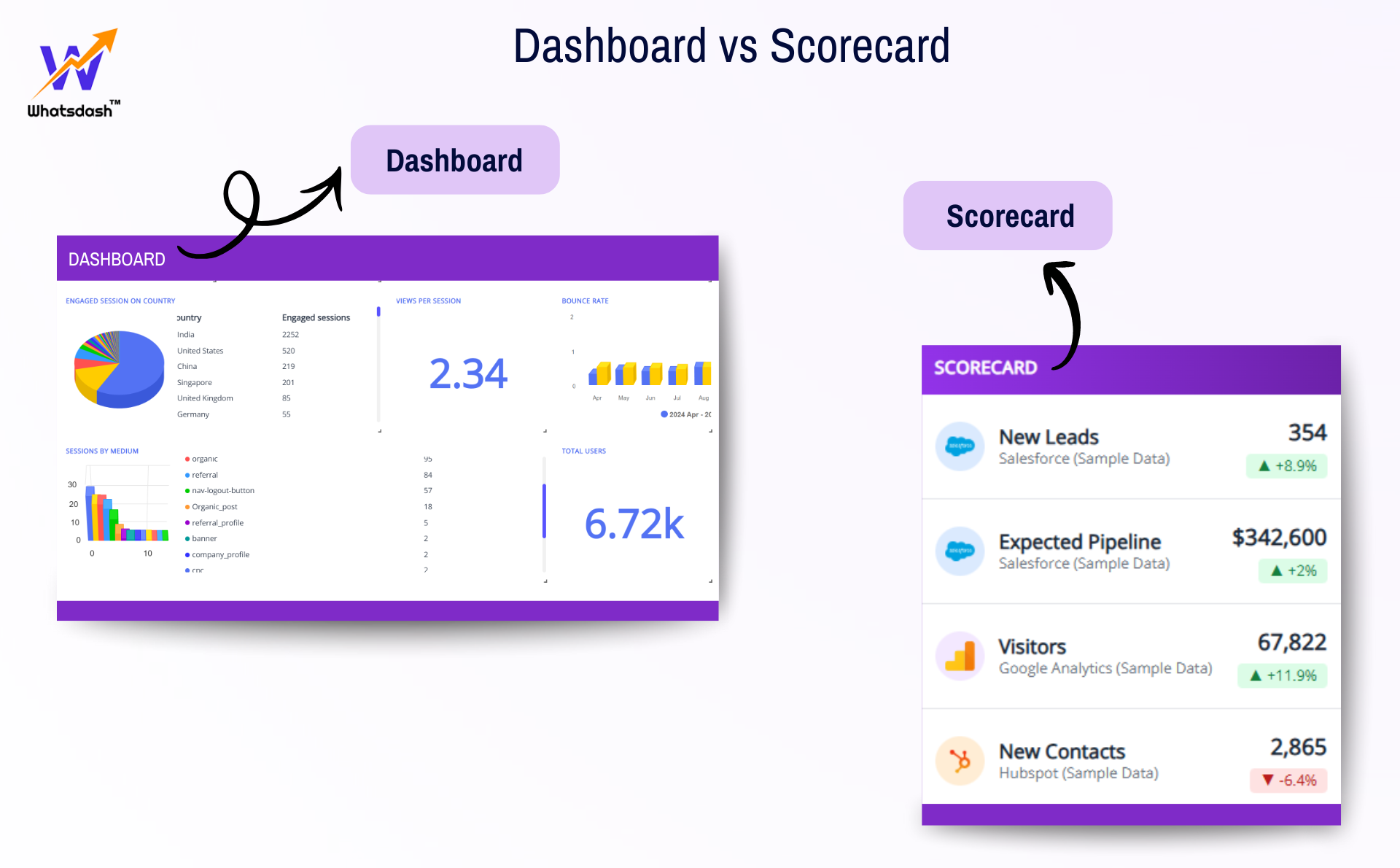
A marketing dashboard is designed to show what is happening right now. Multiple metrics are displayed together to provide context, trends, and patterns. Dashboards are typically visual, interactive, and updated frequently.
A scorecard, on the other hand, is built to answer a simpler question: Are targets being met or not? It focuses on a limited set of KPIs, often compared against goals, benchmarks, or past performance.
In short, dashboards are exploratory, while scorecards are evaluative.
Dashboard vs Scorecard: Key Differences That Matter to Agencies
When comparing dashboard vs scorecard differences, several practical distinctions become important for marketing agencies:
- Purpose: Dashboards help with ongoing monitoring and optimization, while scorecards help with performance evaluation.
- Data Volume: Dashboards contain multiple metrics across channels; scorecards highlight only the most critical KPIs.
- Audience: Dashboards are often used internally by strategists and analysts, whereas scorecards are more client-friendly.
- Frequency: Dashboards may update daily or in real time; scorecards are usually reviewed weekly, monthly, or quarterly.
- Decision Style: Dashboards support tactical decisions, while scorecards support strategic conversations.
Understanding these differences prevents agencies from overwhelming clients or under-informing internal teams.
When Marketing Agencies Should Use a Dashboard
A dashboard becomes valuable when context and trends matter more than single outcomes.
For example, during an active Google Ads campaign, metrics such as impressions, CTR, CPC, conversions, and spend trends need to be monitored together. A dashboard allows patterns to be identified early, enabling adjustments before performance drops.
Dashboards are also useful during:
- Campaign optimization phases
- Internal performance reviews
- Cross-channel analysis
- Troubleshooting traffic or conversion drops
In these situations, a comparison between marketing dashboard and marketing scorecard clearly favors dashboards due to their depth and flexibility. However, a marketing scorecard is also equally important for business growth. So, nowadays companies or agencies are more interested in marketing scorecards than dashboard.
When Marketing Agencies Should Use a Scorecard
A scorecard is more effective when clarity and accountability are required.
For client reporting, stakeholders often want to know whether agreed-upon KPIs were achieved. A scorecard may include metrics such as:
- Organic traffic growth vs target
- Leads generated vs goal
- ROAS compared to benchmark
- Keyword rankings achieved
In these cases, additional charts or granular data may create confusion rather than clarity. Scorecards help agencies maintain focus on outcomes rather than activity.
Dashboard vs Scorecard for Client Reporting
Client reporting is where agencies most often choose the wrong format.
A detailed dashboard shared directly with clients may appear impressive, but it can raise unnecessary questions. Clients may focus on minor fluctuations rather than overall success.
A dashboard vs scorecard for client reporting approach works best when both are used together but presented differently:
- Scorecards should be client-facing, summarizing performance against goals.
- Dashboards should remain mostly internal, supporting deeper analysis when clients ask follow-up questions.
This separation improves trust, reduces reporting friction, and keeps conversations outcome-driven.
Dashboard vs Scorecard Examples from Real Agency Scenarios
Consider an SEO agency managing 20 client accounts.
An internal dashboard may track:
- Daily keyword movements
- Page-level traffic
- Technical SEO health scores
- Backlink velocity
However, the client scorecard may show only:
- Organic traffic growth (%)
- Leads generated from organic search
- Top keyword visibility improvement
Both views use the same data source, but they answer different questions. This practical distinction highlights why dashboard vs scorecard in marketing should not be treated as an either-or choice.
Scorecard vs Dashboard: Which One Is Better for Marketing Agencies?
The answer depends entirely on the objective.
Dashboards are better for execution, optimization, and diagnosis. Scorecards are better for evaluation, alignment, and communication.
For agencies focused on scaling operations, retaining clients, and reducing reporting chaos, the question should not be “which one is better,” but rather “where should each be used.”
Balanced reporting systems almost always include both.
How Reporting Tools Can Support Both
Modern reporting platforms have made it easier for agencies to maintain dashboards and scorecards without manual effort. Data from SEO tools, ad platforms, and analytics can be unified into structured views that serve different audiences.
When reporting workflows are standardized, time spent on data preparation is reduced, and attention can be redirected toward insights and strategy.
However, in practical terms, tools like Whatsdash are designed to support both dashboards and scorecards within a single reporting structure.
Dashboards can be used internally to monitor campaign health across channels, while scorecard-style summaries can be created for clients using the same underlying data. This approach reduces duplication and reporting inconsistencies.
Rather than replacing strategic thinking, such tools help agencies spend less time assembling reports and more time interpreting them—an important distinction for growing teams.
Common Mistakes Agencies Make with Dashboards and Scorecards
Several recurring mistakes are observed across agencies:
- Using dashboards as client reports, leading to confusion
- Including too many KPIs in scorecards
- Reporting metrics without context or targets
- Changing KPI definitions too frequently
- Treating reporting as a task instead of a communication tool
Avoiding these mistakes improves both internal clarity and client confidence.
Conclusion
The Dashboard VS Scorecard debate is not about choosing sides. It is about choosing the right tool for the right moment.
Dashboards help agencies understand what is happening beneath the surface. Scorecards help clients understand whether progress is being made. When both are used intentionally, reporting becomes clearer, conversations become more strategic, and trust is strengthened.
For marketing agencies navigating complex data and high client expectations, clarity in reporting structure is no longer a nice-to-have—it is a competitive advantage.