
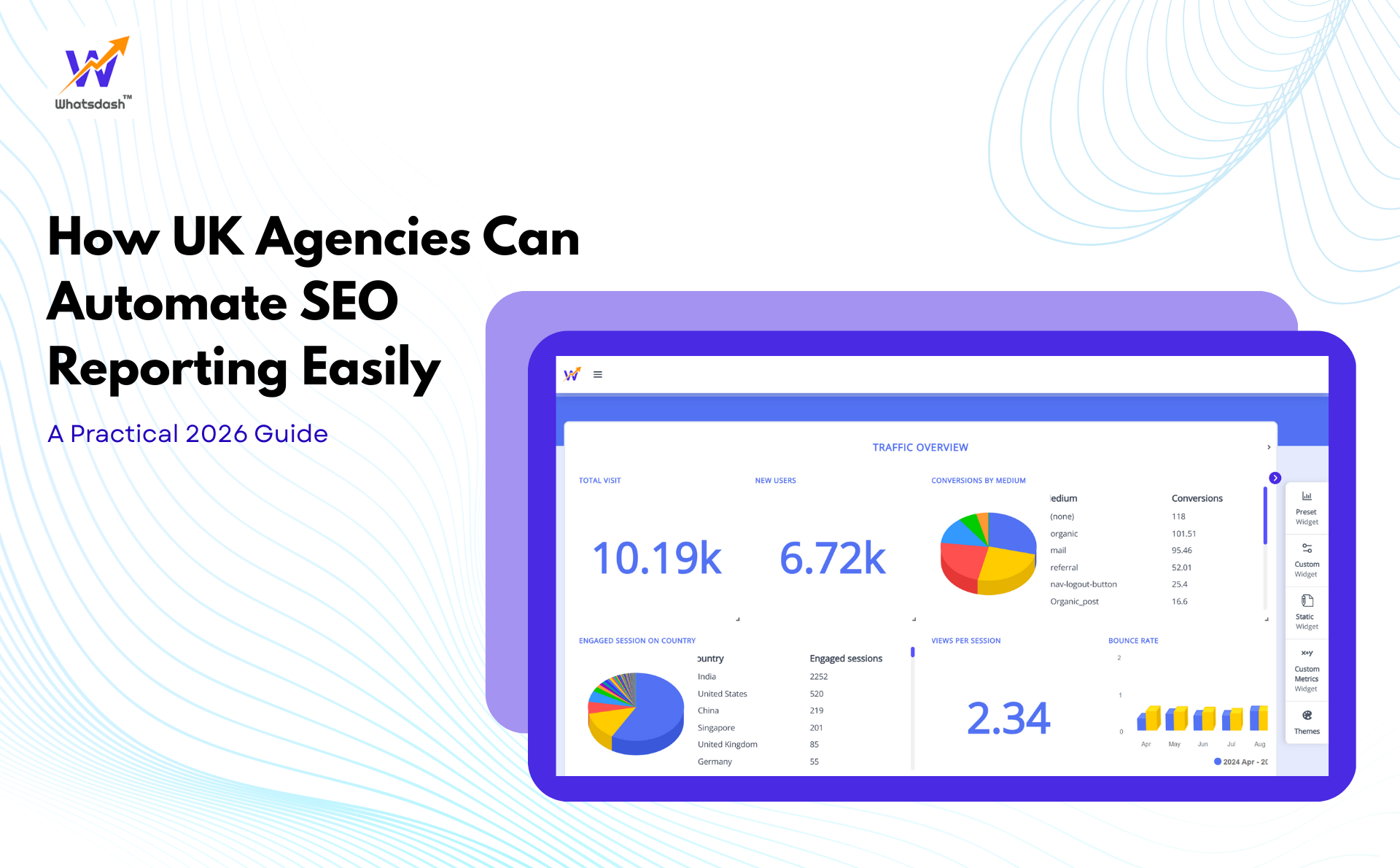
UK digital marketing agencies are under pressure in 2026. Clients expect clearer ROI, faster insights, and more frequent updates, while retainers remain tight and margins are scrutinized. Manual SEO reporting, often built in spreadsheets and slide decks, quietly drains dozens of billable hours each month.
To automate SEO reporting is no longer about convenience. It has become a practical requirement for UK agencies that want to scale accounts, protect profitability, and maintain trust with clients who increasingly understand performance metrics themselves. When reporting is automated properly, time is saved, errors are reduced, and conversations shift from explaining numbers to acting on them.
This guide explains how SEO reporting automation for agencies actually works in practice, what UK agencies should automate (and what they should not), and how modern tools such as Whatsdash support this process without turning reports into sales brochures.
Why SEO Reporting Became a Problem for UK Agencies
UK agencies operate in a results‑driven environment. Clients expect clear proof of performance, often aligned with commercial outcomes such as leads, calls, or revenue. Yet SEO data is spread across multiple platforms.
Common challenges still faced in 2026 include:
- Google Search Console and GA4 data living in separate silos
- Manual exports into spreadsheets every week or month
- Different formats used for different clients
- Reporting deadlines clashing with campaign work
- Difficulty explaining SEO impact to non‑technical UK clients
As reporting volume increases, quality usually drops. Automation was adopted not because it is trendy, but because manual reporting no longer scales.
What it really means to automate SEO reporting
Automating SEO reporting means shifting from manual, repetitive compilation of data into a system where key performance metrics—such as organic traffic, keyword rankings, technical site health and conversion outcomes—are automatically gathered, visualised and delivered without human intervention at every step.
Instead of copying and pasting screenshots or exporting spreadsheets each month, automated SEO reporting uses connected dashboards and scheduled reporting to ensure up-to-date insights are presented clearly, consistently and in a format clients can easily understand. It improves accuracy, saves time and lets agencies focus on analysing trends rather than assembling them.
In practice, automation usually includes:
- Automated SEO dashboards pulling data from live sources
- Scheduled SEO reporting sent weekly or monthly
- Consistent metrics across all clients
- White-label SEO reporting that reflects the agency brand
This allows agencies to focus on trends, actions, and outcomes instead of formatting and data hygiene.
SEO Reporting Automation for Agencies: What It Actually Means
SEO reporting automation does not remove human insight. Instead, repetitive data collection and formatting are handled automatically, allowing teams to focus on analysis.
In practice, SEO reporting automation for agencies involves:
- Continuous data sync from SEO platforms
- Automated dashboards updated in near real time
- Scheduled SEO reporting delivered weekly or monthly
- Standardised metrics across all UK clients
- White‑label presentation to maintain agency branding
Manual vs Automated SEO Reporting (UK Agency View)
Area | Manual Reporting | Automated Reporting |
Time per client | 2–4 hours/month | 10–20 minutes/month |
Data accuracy | Error‑prone | Consistent & validated |
Update frequency | Monthly | Daily or real‑time |
Client clarity | Often confusing | Visual & standardised |
Scalability | Limited | High |
The shift is less about speed and more about consistency and trust.
How to automate SEO reporting: a practical UK-first framework
1. Standardise What UK Clients Actually Care About
Before tools are selected, metrics should be agreed internally. UK clients usually care less about raw rankings and more about outcomes.
Typical core metrics include:
- Organic sessions (GA4)
- Keyword visibility and trend movement
- Conversions from organic traffic
- Top landing pages by performance
- Technical health indicators
These metrics are often grouped into scorecards to make trends easier to understand.
2. Use Automated SEO Dashboards Instead of Static Reports
Static PDFs are still used, but automated SEO dashboards are highly preferred. Dashboards allow clients to check performance without waiting for a monthly email.
For UK agencies, dashboards work best when:
- Data refreshes automatically
- Filters are applied by date and channel
- Explanations are added alongside charts
- Access is controlled per client
Real‑time dashboards have proven particularly useful for retainers where clients expect ongoing visibility.
Step 3: Use scheduled SEO reporting for consistency
Scheduled SEO reporting is often underestimated. UK clients value predictability. When reports arrive on the same day each month, trust increases.
Automation allows reports to be:
- Delivered automatically by email
- Accessed via live links
- Updated without rebuilding decks
This consistency reduces follow-ups and shortens review calls.
4. Apply White‑Label SEO Reporting for Brand Consistency
White‑label SEO reporting ensures that reports appear as part of the agency’s own service, not a third‑party tool.
For UK agencies, this helps:
- Reinforce credibility with enterprise clients
- Maintain consistent visual identity
- Reduce confusion about data ownership
White‑labeling is now considered standard rather than a premium feature. So, agencies should focus on this feature and learn more about how to create white-label reporting dashboard.
Best SEO Reporting Automation Tools (UK Perspective)
Choosing the right tool depends on client volume, data sources, and reporting depth. Below is a practical comparison focused on UK agency needs rather than feature overload.
Tool Type | Strength | Limitation |
Spreadsheet‑based tools | Familiar | Hard to scale |
Native platform reports | Accurate | Limited customisation |
All‑in‑one dashboards | Centralised data | Requires setup |
Custom BI tools | Fully flexible | High cost & complexity |
All‑in‑one reporting platforms have become the most balanced option for small to mid‑sized UK agencies.
How Whatsdash Fits into SEO Reporting Automation
Within many UK agencies, tools like Whatsdash are used not as replacements for expertise, but as infrastructure.
SEO data from platforms such as Google Search Console, GA4, and keyword trackers can be brought into a single reporting environment. Automated dashboards are created once and reused across clients, while scheduled SEO reporting ensures consistent delivery.
Time savings are typically seen in:
- Eliminating repeated exports
- Reducing formatting work
- Aligning metrics across accounts
Whatsdash is often used alongside existing reporting tools or advanced features, acting as the reporting layer rather than the analysis engine.
Real agency workflows
UK agencies managing 20–50 SEO clients typically spend 6–10 hours per month on reporting alone. After automation, this often drops to under 2 hours, mainly spent reviewing insights.
That time is redirected towards:
- Technical fixes
- Content optimization
- Client communication
The quality of service improves without increasing headcount.
Conclusion
To automate SEO reporting in the UK is no longer about efficiency alone. It is about clarity, trust, and scale. UK agencies treat reporting as a system rather than a task that tends to retain clients longer and operate with less friction.
Automation handles repetitive work. Strategy remains human. That balance is what defines effective SEO reporting in 2026.