
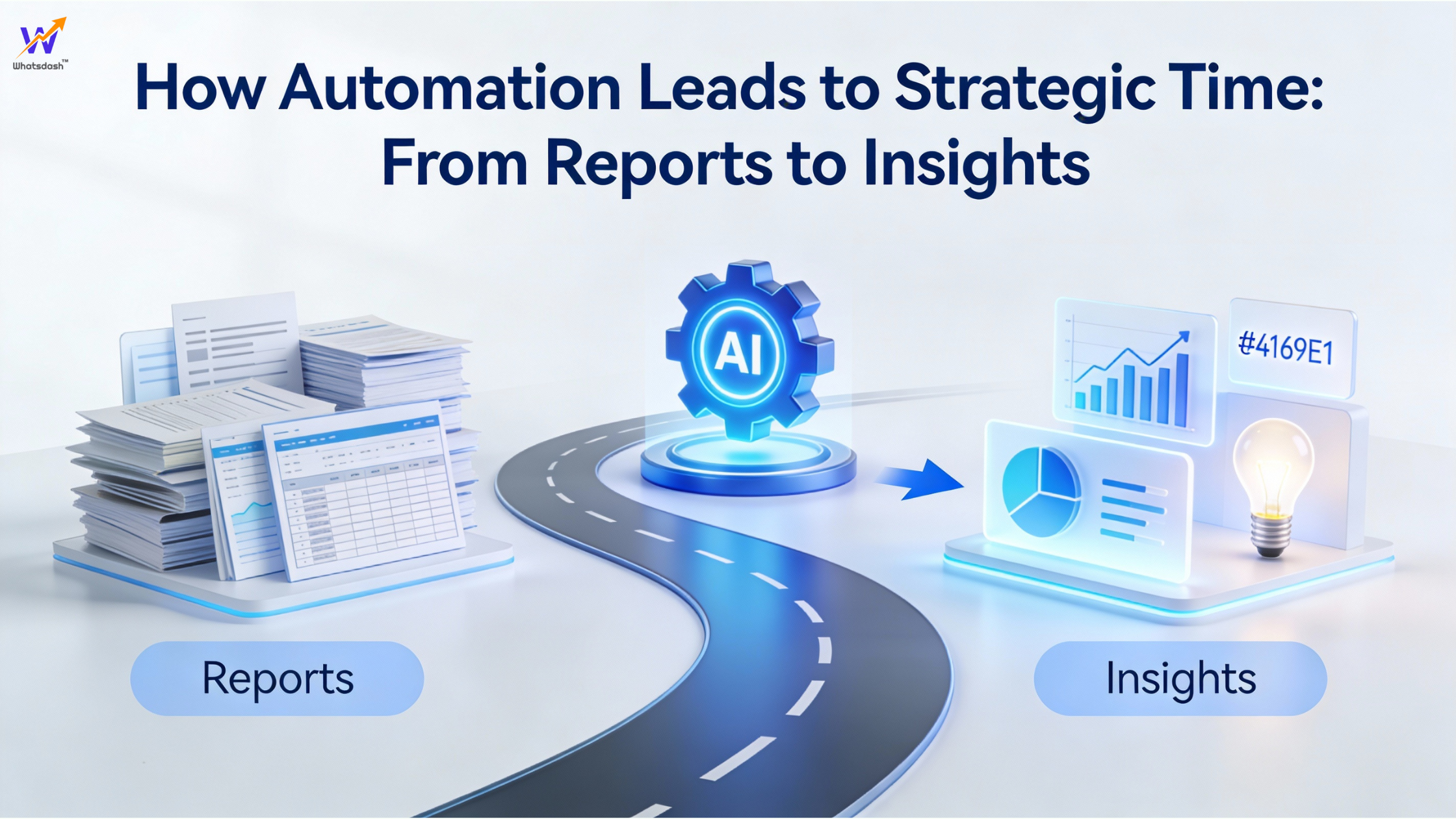
Most agencies are full of smart strategists, analysts, creatives, and performance marketers. Yet day after day, those high-value people spend hours doing low-value work: exporting CSVs, fixing spreadsheets, rebuilding charts, and writing repetitive monthly reports.
The problem isn’t capability.
The problem is time allocation.
When reporting is manual, strategy becomes reactive.
When reporting is automated, strategy becomes the job.
This article explains how reporting automation unlocks strategic time, the hours agencies can reinvest into insight generation, optimization, experimentation, and growth and how this shift transforms agency performance, profitability, and client relationships.
The Hidden Time Trap of Manual Reporting
Before we discuss the benefits of automation, we need to understand what agencies are losing.
How agencies currently spend time
In a typical agency workflow:
- Data collection
- Spreadsheet cleanup
- Chart creation
- Formatting decks
- Writing repetitive summaries
- QA and corrections
These tasks consume 4–10 hours per client per month.
For an agency with:
- 15 clients × 6 hours = 90 hours/month
- 30 clients × 6 hours = 180 hours/month
That is 1–4 full workweeks spent on work that does not directly improve performance.
The opportunity cost
Those hours could be used for:
- Deep performance analysis
- Funnel diagnostics
- Creative testing
- Budget reallocation
- CRO improvements
- Client strategy sessions
- New business development
Instead, they’re spent moving data around.
What Automation Actually Automates (and What It Doesn’t)
A common misconception is that automation replaces thinking.
In reality, automation replaces repetition, not intelligence.
Automation removes
- Manual data pulls
- Spreadsheet formulas
- Repetitive report building
- Copy-paste errors
- Formatting busywork
- Late-night reporting cycles
Automation enables
- Real-time dashboards
- Automated summaries
- KPI trend detection
- Anomaly alerts
- Always-up-to-date reports
What automation does NOT replace
- Strategic judgment
- Insight interpretation
- Creative thinking
- Client advisory
- Decision-making
Automation doesn’t eliminate strategists , it finally frees them.
The Shift: From Reporting Time to Strategic Time
Let’s define two very different kinds of time.
Reporting time
- Reactive
- Repetitive
- Operational
- Non-differentiating
- Low leverage
Strategic time
- Proactive
- Insight-driven
- Advisory
- Differentiating
- High leverage
Automation is the bridge between the two.
Before Automation
A strategist spends:
- 70% of time preparing reports
- 20% of time explaining results
- 10% of time on strategy
After Automation
The same strategist spends:
- 10–15% reviewing dashboards
- 30–40% analyzing patterns
- 45–60% optimizing, advising, and planning
Same person.
Same salary.
Massively different impact.
Where Strategic Time Actually Goes (Practical Examples)
Once reporting is automated, agencies don’t “do nothing” with the extra time. They use it where it matters most.
- Deeper Performance Analysis
Instead of reporting “what happened,” teams can explore:
- Why ROAS dropped in week 3
- Which keyword clusters drive quality leads
- Which creatives fatigue fastest
- Which landing pages leak conversions
- Which channels assist the most revenue
This level of insight requires uninterrupted time which is something automation provides.
- Faster Optimization Cycles
Manual reporting slows optimization.
With automation:
- Daily and weekly insights are always visible
- Issues are spotted early
- Experiments are launched faster
- Budget reallocations happen in real time
Agencies move from monthly optimization to continuous optimization.
- Strategic Budget Allocation
When spend and performance are unified:
- Underperforming campaigns are paused earlier
- High-ROI channels are scaled faster
- Blended ROAS becomes visible
- CAC trends are tracked in real time
This directly improves profitability for both the client and the agency.
- Better Client Strategy Conversations
Automated dashboards change client meetings dramatically.
Before
- “Let me explain this chart…”
- “This number is different because…”
- “We’ll investigate and get back to you…”
After
- “Here’s what changed and why.”
- “Here’s where we recommend shifting budget.”
- “Here’s the experiment we should run next.”
The conversation moves from defense → leadership.
- Proactive Problem Detection
Automation enables alerts and anomaly detection:
- Sudden CPA spikes
- Conversion tracking outages
- Budget overspend
- Ranking drops
- Funnel bottlenecks
Instead of discovering issues in a report weeks later, agencies act immediately.
Quantifying Strategic Time Gained
Let’s run a conservative calculation.
Assumptions
- 15 clients
- 6 hours/client/month previously spent on reporting
- Automation reduces reporting time by 80%
Calculation
- Old reporting time = 15 × 6 = 90 hours/month
- New reporting time = 18 hours/month
- Strategic time gained = 72 hours/month
That’s:
- 72 hours/month
- 864 hours/year
At just $75/hour of strategic value, that time is worth:
- 864 × 75 = $64,800/year
This doesn’t even include performance improvements driven by better decisions.
Why Strategic Time Drives Higher Agency Value
Agencies that operate strategically and not only operationally will win.
Strategic time enables
- Higher retainers
- Advisory positioning
- Better results
- Stronger differentiation
- Lower churn
- Easier upsells
Clients don’t pay premium fees for reports.
They pay for insight, clarity, and direction.
Automation creates the conditions for all three.
The Cultural Impact Inside Agencies
Automation doesn’t just change workflows , it changes culture.
Without automation
- Teams feel overworked
- Analysts burn out
- Strategists feel underutilized
- Reporting is dreaded
- Creativity is squeezed
With automation
- Work feels meaningful
- Teams focus on outcomes
- Analysts grow into strategists
- Reporting becomes invisible
- Innovation increases
This leads to better retention for both clients and employees.
How Automation Enables an Insight-First Operating Model
Modern agencies are shifting from:
“We deliver reports.”
to:
“We deliver insight and direction.”
Automation supports this by enabling:
- Always-on dashboards
- AI-generated summaries
- KPI storytelling
- Cross-channel analysis
- Unified views of performance
Platforms like Whatsdash are built specifically to support this transition, by moving agencies away from reporting factories and toward strategic partners.
The Role of AI in Strategic Time Creation
AI multiplies the impact of automation by:
- Summarizing trends
- Highlighting anomalies
- Explaining performance shifts
- Suggesting actions
- Reducing cognitive load
AI doesn’t replace strategists , it gives them leverage.
The strategist still decides what to do.
AI helps answer what changed and where to look.
What Happens If Agencies Don’t Make This Shift
Agencies that stay manual face:
- Reporting bottlenecks
- Burned-out teams
- Shallow insights
- Price pressure
- Commoditization
- Client churn
- Growth ceilings
Meanwhile, automated agencies:
- Scale without hiring
- Deliver faster insights
- Command higher retainers
- Retain clients longer
- Build defensible differentiation
The gap widens every year.
Summary: Automation Buys Back the Most Valuable Asset and Time
Automation isn’t about saving a few hours on reporting.
It’s about reclaiming strategic time, the time that:
- Improves performance
- Strengthens client relationships
- Increases margins
- Fuels growth
- Makes agency work fulfilling again
When reporting is automated, agencies finally spend time doing what they were hired to do: think, analyze, advise, and lead.
The future of high-performing agencies is not more tools, it’s fewer tools, more insight, and more strategic time.