
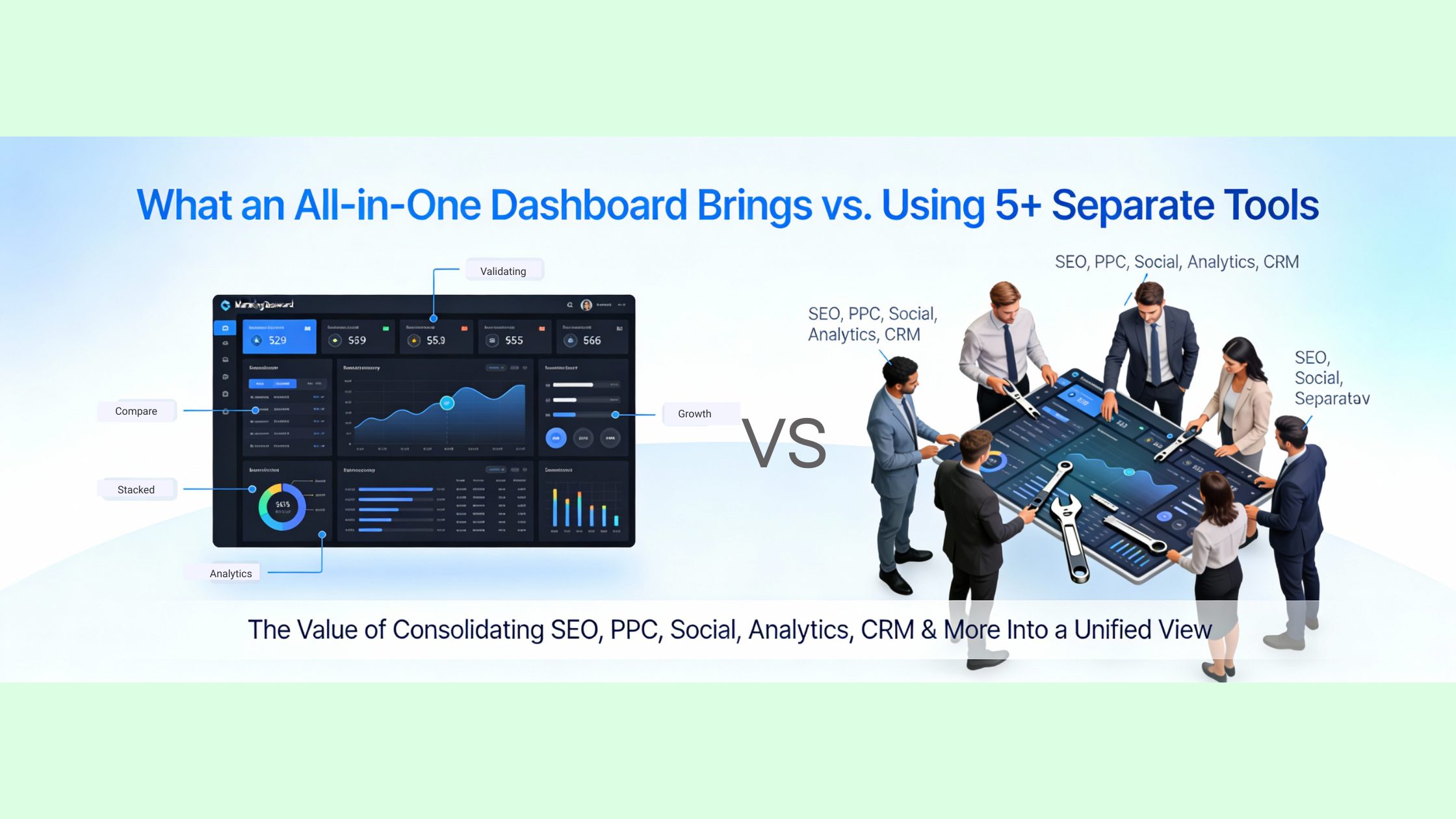
Modern marketing teams and agencies rely on a staggering number of platforms e.g. SEO tools, PPC dashboards, social analytics, CRM systems, attribution models, and spreadsheets. Each platform serves a purpose, but together they create data chaos: conflicting metrics, mismatched date ranges, missing context, and hours of manual stitching.
The average digital agency today uses 5–12 tools just to assemble a single monthly report.
But the real cost isn’t the subscription fees, it’s the inefficiency, errors, time drain, and lost strategic clarity caused by scattered data.
That’s where all-in-one reporting dashboards come in. These unified platforms bring all marketing and sales data together under one roof, giving teams a single source of truth. This article breaks down exactly what an all-in-one dashboard delivers compared to juggling multiple disconnected tools and why consolidation has become mission-critical for agencies and marketing teams in 2025.
The Real Problem With Using 5+ Separate Tools
Before exploring the benefits of a unified dashboard, it’s important to understand the structural problems created by fragmented reporting systems.
Problem 1: Fragmented data = fragmented decisions
Every tool shows a different part of the picture:
- GA4 shows sessions, conversions, engagement
- Google Ads shows spend and conversion actions
- Facebook Ads shows attributed conversions (often inflated)
- Search Console shows impressions & click data
- SEO tools show rankings and backlinks
- CRM shows SQLs, revenue, and pipeline
When these data points live separately, it becomes impossible to answer basic strategic questions like:
- Which channel actually drives the highest ROI?
- Where are we losing money in the funnel?
- How does paid traffic behave vs organic traffic?
- What campaigns drive the most revenue, not just clicks?
A decision made from fragmented data is a decision made with partial truth and sometimes, the wrong truth.
Problem 2: Reporting takes hours or even days
When your insights are scattered, reporting becomes a nightmare. Agencies routinely spend:
- 4–10 hours per client per month
- Pulling exports
- Cleaning data
- Aligning date ranges
- Rebuilding charts
- Writing summaries manually
If you have 15 clients, that’s 60–150 hours every month wasted on tasks that should already be automated.
Problem 3: Metrics don’t match from platform to platform
Ask any agency:
“Why are conversions different between Google Ads, Facebook Ads, and GA4?”
It’s not a bug , it’s attribution differences. When each platform reports conversions differently, teams lose trust in their own numbers.
The result?
- Confusion
- Inefficiency
- Budget misallocation
- Client frustration
Problem 4: Insights are reactive instead of proactive
With manual reporting, by the time someone notices:
- A budget overspend
- A drop in ROAS
- A ranking decline
- A spike in CPM
- A page-speed issue
- A drop in lead quality
…the damage is already done.
Fragmentation causes data lag and lag kills performance.
Problem 5: No single source of truth
Executives ask:
“What’s really happening across all channels?”
Agencies answer with:
- Screenshots
- CSV files
- Contextless charts
- Conflicting interpretations
When clients and teams see different numbers from different tools, credibility drops. Confusion rises.
A unified dashboard like Whatsdash fixes this instantly.
What an All-in-One Dashboard Actually Brings
Consolidation isn’t just convenience, it’s a competitive advantage.
Here are the core benefits of unifying SEO, PPC, social, analytics, CRM, and revenue data in one place.
- A Single Source of Truth for All Data
When everything lives in one dashboard, you get:
- Consistent metrics
- Unified date ranges
- Standardized definitions
- One place to validate performance
This eliminates contradictions between tools and allows leadership, marketers, and clients to align on:
✔ What is happening
✔ Why it’s happening
✔ What needs to be done
Unified data = unified strategy.
- True Cross-Channel Insights (Finally!)
A unified dashboard can answer questions no individual tool can:
Which channel actually drives the most revenue?
- Compare Google Ads ROAS vs Meta Ads ROAS
- Compare organic-assisted conversions vs paid conversions
- Compare email-driven revenue vs social engagement
Which traffic source has the highest intent?
View differences in:
- Engagement rate
- Conversion rate
- AOV
- LTV
- Cost of acquisition
Where is the funnel leaking?
See drop-offs between:
- Ad click
- Landing page view
- Add to cart
- Checkout
- Purchase
No single platform can show this alone but a unified dashboard can.
- Faster, Automated Reporting (Save 60–90% of Time)
With an all-in-one platform:
- Data syncs automatically
- Reports update in real time
- Dashboards can be duplicated across clients
- AI can generate insights instantly
- PDFs or links can be auto-delivered
What used to take hours now takes minutes.
This is especially powerful for agencies managing 10, 20, or 50+ clients.
- Elimination of Spreadsheet Chaos
Spreadsheets introduce:
- Formula errors
- Copy/paste mistakes
- Broken charts
- Wrong date ranges
- Outdated data
- Human-error risk
An all-in-one dashboard eliminates all of this:
✔ No more exporting
✔ No manual merging
✔ No broken formulas
✔ No last-minute scrambling
The risk drops to almost zero.
- Real-Time Performance Monitoring
Instead of waiting for a monthly report, teams get instant visibility:
- Daily spend pacing
- Real-time ROAS
- Live keyword rankings
- Hourly conversion fluctuations
- New vs lost backlinks
- CRM pipeline updates
This enables proactive optimization, not reactive cleanup.
Imagine catching:
- A 40% overspend on Google Ads in 30 minutes
- A sudden drop in CTR within hours
- A critical landing page outage instantly
- A ranking drop before traffic tanks
This is only possible with live, consolidated data.
- AI-Powered Insights Across Channels
With all data in one system, AI can finally do what it’s meant to:
- Identify anomalies
- Summarize performance
- Recommend actions
- Explain changes
- Attribute results properly
- Predict outcomes
When data is fragmented, AI is blind.
When data is unified, AI becomes transformational in one reporting tool.
This is where tools like Whatsdash are redefining agency reporting.
- Better Client Experience + Higher Retention
Clients get:
- One link
- One dashboard
- One narrative
- One source of truth
- One place to check progress
Instead of 10 screenshots or 5 separate logins, they see:
- SEO performance
- PPC spend
- Social engagement
- CRM pipeline
- Email results
- Revenue attribution
…all in one place.
Clients understand the value instantly , which boosts trust and retention.
- Reduced Tool Costs (Kill Redundant Subscriptions)
Agencies often overpay for:
- SEO tracking
- Funnel analytics
- Social analytics
- Client dashboards
- Attribution tools
A consolidated platform often replaces 3–7 tools, reducing:
- Subscription costs
- Training costs
- Onboarding friction
- Data inconsistency
One tool > Many tools.
- Operational Scalability for Agencies
Manual reporting caps your growth.
Let’s say a strategist can produce 10 client reports/month manually.
With an all-in-one dashboard, they can handle 40+.
Scaling becomes:
- Linear → Exponential
- Stressful → Predictable
- Labor-heavy → Technology-enabled
Agencies that consolidate outperform those that don’t.
- Better Collaboration Across Teams
A unified dashboard helps align:
- SEO teams
- PPC teams
- Social teams
- Creative teams
- Data analysts
- Sales teams
- C-suite
Everyone sees the same numbers, story, and KPIs.
No more blame-shifting (“That’s not my channel’s fault”) and no more siloed strategies.
Unified dashboards build unified teams.
What Using 5+ Separate Tools Looks Like vs. One Dashboard
Let’s compare real workflows.
The Old Way (5–12 tools)
A strategist must:
- Log into GA4
- Export landing page data
- Log into Google Ads
- Pull spend + conversions
- Log into Facebook Ads
- Export CTR and CPAs
- Log into Semrush/Ahrefs
- Pull ranking and backlink metrics
- Log into CRM
- Export SQLs, pipeline status
- Merge everything into spreadsheets
- Rebuild charts
- Write insights manually
- QA everything
Result: 4–10 hours per report
Stress level: High
Accuracy: Medium
Scalability: Low
The New Way (one dashboard)
A strategist:
- Opens the client’s all-in-one dashboard
- Reviews real-time insights (auto-generated)
- Adds commentary
- Clicks “Send report”
Result: 15–30 minutes per report
Stress level: Low
Accuracy: High
Scalability: High
Why Consolidation Has Become Essential in 2025
Three major trends have made unified dashboards unavoidable:
Trend 1 — Multi-channel marketing complexity has exploded
No channel works in isolation anymore.
SEO supports paid.
Paid supports social.
Social supports email.
Email supports retention.
CRM supports revenue forecasting.
Only an integrated dashboard can reflect these relationships.
Trend 2 — Clients now demand transparency
Clients want:
- Real-time access
- Clear attribution
- Intelligent insights
- Outcome-focused reporting
A single dashboard with consistent KPIs is the new expectation.
Trend 3 — AI is only as good as the data you give it
Fragmented data = weak AI.
Unified data = powerful AI.
AI-driven reporting requires consolidated, well-structured, cross-channel datasets which all-in-one dashboards provide.
How Whatsdash Embodies the All-in-One Dashboard Advantage
While this article is tool-agnostic, here’s what a modern all-in-one platform like Whatsdash delivers:
✔ SEO (GA4, GSC, rankings, backlinks)
✔ PPC (Google Ads, Meta Ads, LinkedIn, TikTok)
✔ Social insights (organic + paid)
✔ E-commerce revenue (Shopify, WooCommerce)
✔ CRM + pipeline metrics
✔ Email platform performance
✔ AI-generated insights
✔ Automated reporting cycles
✔ White-label dashboards for clients
✔ Cross-client views for agencies
This is exactly the consolidation marketing teams have needed for years.
Conclusion: Consolidation Isn’t Just Convenient, It’s Transformational
Using 5 – 12 tools may feel normal, but it is not efficient, scalable, or sustainable.
An all-in-one dashboard delivers:
- Unified data
- Clear insights
- Faster reporting
- Higher accuracy
- Better collaboration
- Stronger client retention
- Lower costs
- Higher revenue
- A more strategic, empowered team
The question is no longer:
“Should we consolidate our reporting?”
The real question is:
“How much time, money, and opportunity are we losing by not consolidating?”
The future of marketing reporting is unified, automated, and intelligent and all-in-one dashboards make that future possible today.